 By Oleg Ort ·
What Are Channel Letters and How to Use Them for Business Signage and Visibility
A regional coffee chain opening its first late-night location faced a specific challenge: the storefront needed to be just as visible to customers at 9 PM as it was at 9 AM, in a retail corridor where most neighboring businesses closed by early evening. Daytime signage wouldn’t be enough – the location needed a sign that worked as hard after dark as it did under daylight. The solution the chain’s sign contractor proposed was a set of illuminated channel letters spelling out the brand name in the company’s signature red, mounted above the entrance with internal LED modules. The difference was immediate: the location became the single most visible storefront on the block after sunset, drawing in passing traffic that competing dark or dimly lit storefronts simply couldn’t capture. Channel letters are the most established and widely used illuminated signage format in commercial business for exactly this reason – they solve the day-and-night visibility problem better than almost any other sign type. This guide explains exactly what channel letters are, how they work, and how to use them effectively for your own business.

What Channel Letters Are and How They’re Constructed
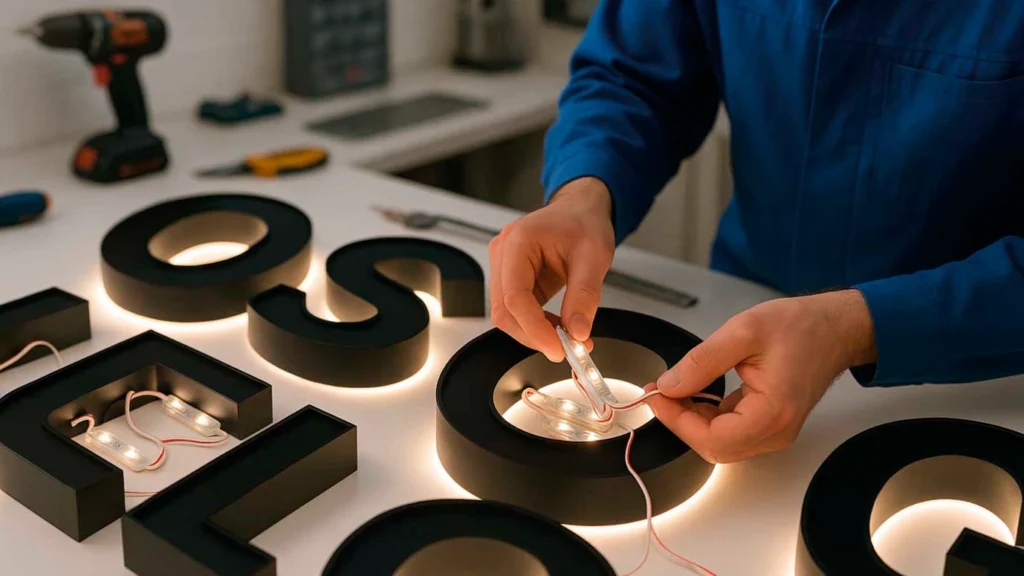
Channel letters are individually fabricated, three-dimensional letters – typically metal-bodied with an illuminated face – that are mounted directly to a building facade, raceway, or storefront structure to spell out a business name or message. The term “channel” refers to the construction method: each letter is built as a hollow channel or box, with a metal return (the side wall) forming the depth of the letter and a translucent face material covering the front opening, behind which the illumination source is mounted.
The standard construction of a channel letter starts with the return – the side walls of the letter, almost always fabricated from aluminum coil stock formed to the letter’s outline and depth. Aluminum is used because it’s lightweight, corrosion-resistant, and accepts paint and trim cap finishes well. Letter depth typically ranges from about 3 to 5 inches for standard storefront applications, though larger letters intended for greater viewing distances may use additional depth to accommodate brighter or more even illumination.
The face is the visible front surface of the letter, almost universally fabricated from acrylic in a specific translucent color matched to the brand’s identity. Acrylic is chosen for channel letter signage specifically because of how evenly it transmits and diffuses light from the LED modules mounted behind it, producing the smooth, even glow that customers associate with traditional illuminated storefront signage. The face is held in place by a trim cap – a thin plastic or aluminum strip that runs around the perimeter of the letter face, both securing the acrylic and providing a clean, finished edge.
The back of the letter is typically aluminum as well, fully enclosing the channel and providing a mounting surface for the internal electrical components. Modern channel letters are illuminated almost exclusively with LED modules – small clusters of light-emitting diodes mounted on a circuit board strip and positioned inside the letter channel to evenly illuminate the acrylic face from behind. Older channel letter installations sometimes used neon tubing for illumination, but LED has become the dominant technology because of its lower power consumption, longer operational life, lower heat generation, and reduced maintenance requirements compared to neon.
Channel letters are wired together and connected to a power supply (transformer) that’s typically mounted out of sight – either inside the building, in an attic space, or within a raceway (a metal housing mounted to the wall that conceals the wiring connecting multiple letters together). Some installations mount letters directly to the building facade without a raceway, in which case the electrical connections are routed through conduit penetrations in the wall, a method generally preferred for its cleaner appearance when the facade construction allows it.
Why Channel Letters Are Effective for Business Visibility
The popularity of channel letter signs across virtually every retail and commercial sector isn’t accidental – the format solves a specific set of visibility problems more effectively than most alternative sign types, and understanding why clarifies when channel letters are the right choice for a given business.
Dual-mode visibility is the core advantage. During daylight hours, channel letters function as dimensional signage: their depth catches shadow and highlight as ambient light changes throughout the day, making them more visually prominent than flat printed or painted signage of equivalent size. After dark, the same letters become self-illuminated, producing strong, even, colored light that remains highly visible regardless of ambient lighting conditions. This combination means a single sign investment delivers strong visibility across the full 24-hour cycle, which is particularly valuable for restaurants, retail stores, pharmacies, and any business with extended or evening operating hours.
Brand color accuracy is another significant advantage of illuminated channel letters business applications. Because the acrylic face material is manufactured in an extensive range of translucent colors, channel letters can be specified to match a brand’s exact color identity – not just an approximation, but the specific Pantone-matched hue the brand uses everywhere else. This consistency matters because customers build visual brand recognition partly through color, and a storefront sign in the wrong shade of the brand color undermines that recognition even if the logo and typography are otherwise correct.
Energy efficiency has become an increasingly important factor as LED technology has matured. LED channel letters consume dramatically less electricity than older neon-illuminated signage while producing equal or greater brightness, and they generate far less heat – a meaningful consideration for the electrical components and the trim cap material, which can degrade under sustained heat exposure from older lighting technologies. Lower power draw also means lower ongoing operating costs over the sign’s lifespan, a detail that matters for businesses operating illuminated signage for 12 or more hours daily.
Durability and weather performance of properly fabricated channel letters is excellent. Aluminum returns and backs resist corrosion without ongoing maintenance, acrylic faces resist UV fading far better than printed graphics, and the sealed construction of a quality channel letter prevents water infiltration into the electrical components. This combination makes channel letter signs outdoor installations among the most reliable and long-lasting illuminated signage formats available, with properly installed and maintained letters commonly performing well for 10 years or more.
Visual impact and brand perception round out the practical advantages. A business with professionally fabricated, properly illuminated channel letters signals investment and permanence to customers in a way that banners, temporary signage, or basic flat panels generally cannot match. For businesses competing in retail corridors, strip centers, and commercial districts where multiple competitors are visible within the same sightline, this perceived investment can be a meaningful differentiator in customer decision-making, particularly for categories like restaurants and retail where perceived quality influences purchase decisions before a customer ever walks through the door.
Types of Channel Letters: Standard, Halo-Lit, and Open-Face Designs
Not all channel letters use the same lighting configuration, and choosing the right type affects both the visual effect and the cost of your installation. Understanding the major variations helps clarify which approach fits your brand and budget.
Standard front-lit channel letters are the most common and traditional configuration, where the acrylic face is illuminated from behind by LED modules and light is visible through the front face of the letter, producing the classic glowing-letter appearance recognized from decades of storefront signage. This is the most cost-effective illuminated configuration and provides the strongest, most direct visibility – the letters themselves are bright and easily read from significant distances, day or night. Standard channel letters remain the default choice for the large majority of retail, restaurant, and commercial storefront applications.
Halo-lit (back-lit) channel letters reverse the lighting orientation: LED modules are mounted to illuminate outward from behind the letter, projecting light onto the wall surface behind and around the letter’s silhouette rather than through the face. This produces a glowing halo or outline effect around each letter rather than a brightly lit letter face. Halo lighting requires the letters to be mounted on standoffs that create a gap between the letter back and the wall surface, allowing light to spill outward. This configuration has become especially popular for upscale retail, corporate offices, hospitality branding, and professional services that want a more sophisticated, contemporary aesthetic than the brighter, more commercial look of standard front-lit letters. Halo-lit 3d channel letters generally cost somewhat more than standard configurations due to the additional standoff hardware and mounting complexity.
Open-face channel letters expose the LED modules directly, without an acrylic face covering the front opening, producing individual points of visible light along each letter’s stroke rather than an evenly diffused glow. This creates a distinctive, retro-style visual effect that has seen renewed popularity for businesses seeking a vintage, theatrical, or nostalgic brand aesthetic – restaurants, entertainment venues, and retail brands leaning into a deliberately retro identity frequently choose this configuration specifically for its visual character. Open-face letters require careful spacing and module selection to avoid an uneven or “hot spot” appearance, and they’re generally less weather-sealed than enclosed-face configurations, making proper installation quality especially important for outdoor durability.
Combination and front-and-halo-lit letters illuminate both the face and the back simultaneously, providing the bright direct visibility of standard channel letters along with the ambient wall-glow effect of halo lighting. This configuration delivers maximum visual impact and the strongest possible illumination but carries the highest fabrication and electrical cost of the common channel letter types, generally reserved for flagship locations or brand applications where maximum visibility and visual impact justify the additional investment.
Choosing among these types comes down to brand positioning as much as budget: standard front-lit letters communicate strong, direct commercial visibility; halo-lit letters communicate sophistication and subtlety; open-face letters communicate character and nostalgia. Discussing your brand positioning goals with your channel letter company before finalizing the lighting configuration ensures the finished sign actually reinforces the brand impression you’re trying to create.
Cost, Installation, and Choosing the Right Channel Letter Company
Understanding what drives channel letters cost and what to look for in a fabrication and installation partner helps businesses budget accurately and avoid the most common problems that arise from working with under-qualified contractors.
Cost factors for custom channel letters include letter size and quantity, depth and material gauge, lighting configuration (standard front-lit is generally least expensive, with halo-lit and combination configurations costing more), face acrylic color and any custom color matching requirements, and installation complexity including mounting method, electrical work, and whether a raceway is required. Smaller installations – a short business name in modest letter heights mounted to a straightforward facade – represent the lower end of typical project cost, while large letter sets, complex logos integrated with the letters, or installations on challenging facades (masonry requiring specialized anchoring, or significant height requiring lift equipment) increase cost meaningfully. Obtaining quotes from multiple channel letter companies for an identical specification – same size, same lighting type, same materials – is the most reliable way to evaluate whether a quote is competitive, since cost can otherwise vary substantially based on factors that aren’t always made clear upfront.
Installation considerations begin with permitting. Most municipalities require permits for illuminated commercial signage, with regulations covering maximum size, brightness, and sometimes specific restrictions on color or illumination type depending on the zoning district. A qualified channel letter company should handle or directly advise on the permitting process as part of the project scope – this is a meaningful indicator of fabricator quality, since inexperienced or unlicensed contractors frequently skip this step, leaving the business owner exposed to forced removal or fines after installation.
Electrical coordination is essential for any channel letters installation, since the sign requires a dedicated power connection, an appropriately sized transformer, and in most jurisdictions, a licensed electrician to make the final connection to the building’s electrical system. Confirm before installation that the building has adequate electrical capacity at the sign location and that any required disconnect switches, timers, or photocells (which automatically turn the sign on at dusk and off at dawn) are specified correctly for the business’s operating needs.
Mounting method depends on the facade material and whether a raceway is used. Raceway-mounted installations conceal all wiring within a single housing attached to the wall, simplifying installation and electrical access for future maintenance, though the raceway itself is visible as a horizontal bar behind the letters – some businesses prefer this practical tradeoff, while others prefer the cleaner appearance of individually mounted letters with conduit routed through the wall, which requires more precise facade penetration work but eliminates the visible raceway housing.
Evaluating a channel letter company near you should go beyond comparing price quotes alone. Ask to see examples of completed installations, ideally including some in your own facade material type and climate. Ask specifically about their LED module brand and warranty – LED quality varies significantly between manufacturers, and a company using premium, well-warrantied modules is a meaningful indicator of overall fabrication quality. Confirm what warranty terms apply to both the fabrication (returns, faces, trim caps) and the electrical components (LED modules and transformers), since these have different expected lifespans and failure modes. A fabricator who answers these questions clearly and proactively is generally a more reliable choice than one who simply quotes a price based on letter count and size alone.
Frequently Asked Questions
What are channel letters?
Channel letters are individual three-dimensional letters with internal lighting, commonly used for storefront signage to spell out a business name or message directly on a building facade. They are constructed with aluminum returns and backs, an illuminated acrylic face, and internal LED modules, providing high visibility both during the day, through their dimensional form and shadow, and at night, through their internal illumination.
Are channel letters illuminated?
Yes, most channel letters use LED lighting, which makes them bright, energy-efficient, and long-lasting compared to older illumination technologies like neon tubing. LED channel letters consume significantly less power, generate less heat, and require less maintenance over their operational life, which is why they have become the dominant illumination method for channel letter signage and one of the most popular illuminated signage solutions for commercial storefronts.
Where are channel letters used?
Channel letters are typically installed on storefronts, shopping centers, restaurants, office buildings, and commercial facades wherever a business needs strong brand visibility across both daytime and nighttime hours. They are especially common in retail corridors, strip centers, and commercial districts where multiple competing businesses are visible within the same sightline, since the dimensional, illuminated format provides a meaningful visibility advantage over flat or non-illuminated alternatives.
How long do channel letters last?
With proper materials and professional installation, channel letters can last many years – commonly a decade or more – with minimal maintenance required. LED components are durable and energy-efficient, typically rated for tens of thousands of hours of operation, and the aluminum and acrylic construction resists corrosion and UV fading far better than printed or painted alternatives when properly fabricated and sealed against moisture. The most common maintenance need over a channel letter sign’s lifespan is occasional replacement of an individual LED module or transformer rather than any structural failure of the letters themselves.
Conclusion
The honest takeaway on channel letters is that their enduring popularity across virtually every retail and commercial category isn’t a matter of trend – it’s because the format genuinely solves the dual problem of daytime and nighttime visibility better than most alternatives, while remaining durable enough to deliver a decade or more of reliable service with minimal upkeep. The variables that actually determine whether a specific channel letter installation succeeds are lighting configuration matched to brand positioning, quality of materials and LED components, and a fabricator who handles permitting, electrical coordination, and mounting correctly. Get those details right, and channel letters will do exactly what they’re designed to do: make your business unmistakably visible, around the clock, for years to come.

Read more

The Importance of Hard Coating in Outdoor Signage: How Polyurea Coating Transforms Foam Structures into Durable Signage
The Art of Imitation: How Faux Finishes Transform EPS Foam Into Stone, Metal & Wood

Beyond Traditional Materials: Why HDU Foam Is Replacing Wood and Stone in High-End Signage
The Hidden Science Behind High-Quality Foam Lettering & Dimensional Signage
Eco-Friendly Signage Solutions: Is HDU & EPS Foam the Sustainable Choice?

Why Lightweight Foam Monument Signs Are Ideal for Large-Scale Signage

The Importance of Proper Installation for Monument Signs

Foam vs. Metal Signs: Cost, Durability, and Aesthetic Considerations

The Importance of Proper Installation for Monument Signs

From One-Time WOW to Multi-Tour ROI
Recommended Articles
Blade Signs and Projecting Signs: Getting Your Storefront Seen by People Walking Past

Holiday Storefront Displays: Dimensional Signs and 3D Props That Drive Winter Foot Traffic
3D Logo Signs for Lobbies and Offices: Choosing Material, Thickness, and Mounting
PVC Letters and Logos for Business Signage: Durable, Lightweight, and Fully Customizable
HDU Signs: What High-Density Urethane Foam Is and Why It’s a Premium Sign Choice
Acrylic Signs for Business: Types, Benefits, and How to Choose the Right Style
Our customer reviews
Read more reviewsRead more reviews