 By Oleg Ort ·
Holiday Storefront Displays: Dimensional Signs and 3D Props That Drive Winter Foot Traffic
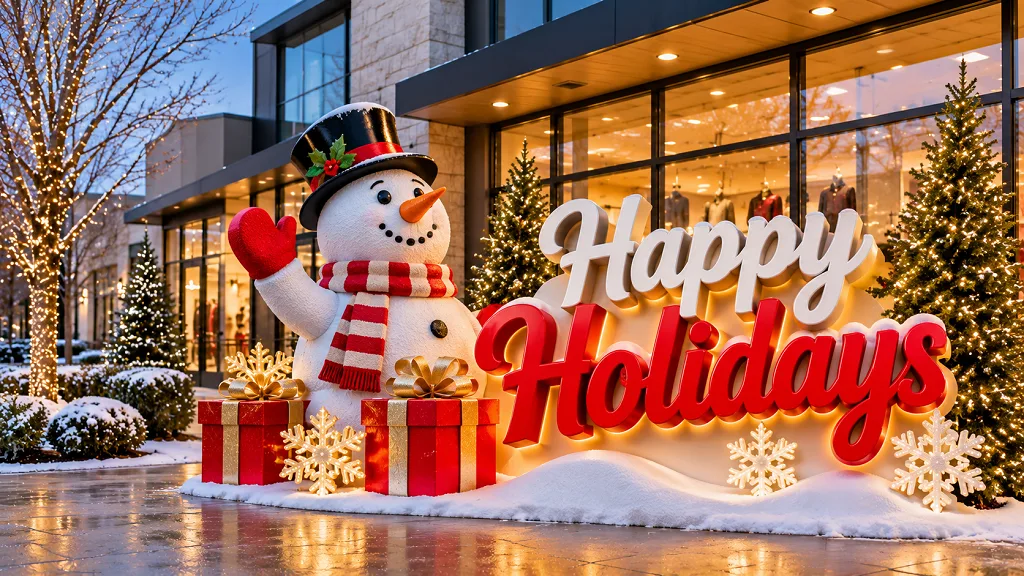
A holiday storefront display built from dimensional signs and three-dimensional props turns a flat glass window into a stage that stops pedestrians, pulls them inside, and keeps your brand in their memory long after the shopping trip ends. Unlike printed banners or vinyl clings that flatten into the background, a 3D holiday sign projects outward from the facade, catches light from multiple angles, and creates depth that the eye registers as craftsmanship and investment. The most effective holiday storefront display programs combine sculptural foam letters, oversized ornament props, and layered window backdrops into a unified scene that tells a seasonal story in under three seconds of sidewalk viewing time. Retailers who commit to dimensional holiday decor consistently report foot-traffic increases of ten to thirty percent during the November-through-January window compared to seasons when they relied on two-dimensional graphics alone.
The Visibility Problem Every Retailer Faces in Winter
Winter shopping districts are visually noisy. Every storefront competes with string lights, projected snowflakes, and digital screens cycling through promotions. Flat signage disappears into that clutter because it occupies the same visual plane as every other printed surface on the block. At the same time, shorter daylight hours mean a large share of shopping happens after dark, when color contrast drops and fine print becomes unreadable from across the street. A retailer whose holiday presence relies on posters and window decals is essentially invisible to a pedestrian walking on the opposite sidewalk at five in the afternoon in December.
Dimensional props solve both problems at once: they break the plane of the facade, creating shadows and highlights that read as real objects rather than images, and they accept side lighting, spotlighting, and internal LED illumination that makes them glow against the dark streetscape. The result is a storefront that communicates quality, festivity, and invitation at distances and in lighting conditions where flat graphics fail entirely.
The financial stakes are real: the National Retail Federation estimates that holiday sales account for roughly twenty percent of annual retail revenue, and the storefront is the first and most persistent touchpoint with the foot-traffic customer who has not yet decided which door to enter. A seasonal dimensional display that captures even a few extra walk-ins per day during the six-week holiday selling window can shift the revenue needle enough to pay for the display several times over.
How Dimensional Signs and Props Are Constructed for Retail Use
Winter retail signage in three-dimensional form starts as a concept drawing or a digital model that the fabrication shop translates into CNC tool paths. Expanded polystyrene is the most common core material because it is light enough to mount on glass, stucco, or metal facades without structural reinforcement. Letters, logos, and decorative shapes are routed from EPS blocks, then coated with a hard shell, typically acrylic gesso, polymer-modified cementitious base, or a thin polyurea layer, that gives the surface paintability and impact resistance. For a 3D holiday sign that will hang outdoors, the coating also provides weather protection against rain, snow, and freeze-thaw cycling.
Paint finishes include matte, satin, metallic gold and silver, and glitter-infused clear coats for a festive sparkle. Beyond foam, Christmas storefront props can incorporate acrylic panels for backlit elements, vacuum-formed plastic shells for lightweight ornament shapes, and metal armatures for oversized candy canes or lamppost toppers that need to resist wind loads.
The fabrication team sizes each element to the storefront’s proportions: a ten-foot-wide window calls for a primary prop in the three-to-four-foot range, while a thirty-foot facade can support a full sculptural vignette with elements up to six feet tall. Scale matters because an undersized prop looks like an afterthought, while an oversized one blocks the view of merchandise inside.
Color palettes for a 3D holiday sign should coordinate with the store’s brand colors rather than defaulting to generic red and green; a luxury jeweler might use matte white and gold, a children’s toy store might use candy-bright primary colors, and a home-goods retailer might use muted evergreen and copper. Consistent branding across the dimensional elements and the interior merchandising creates a visual tunnel that draws the customer from the sidewalk through the door and into the selling floor without a cognitive disconnect. Seasonal dimensional display elements that integrate the brand identity rather than overriding it perform better over multiple seasons because they reinforce recognition rather than competing with it.
Getting the Most from Your Holiday Display Investment
Plan the display as a system, not a collection of parts. Start with a focal-point prop, a dimensional sign with the store name or a hero seasonal element, and build outward with supporting pieces that fill the window plane at varying depths. Use risers, shelves, and hanging hardware to create at least three layers of depth inside the window bay, because layering is what separates a professional seasonal dimensional display from a single prop sitting on a table.
Light the display from at least two angles: a warm downlight from above and a cooler accent from below or from the side to fill shadows and make textures pop. Swap LED color temperature with the season, warmer amber tones for Thanksgiving and Christmas, cooler white for a January clearance sale, to keep the display fresh without changing any physical elements.
Specify removable mounting hardware so the display goes up and comes down in under two hours, minimizing the time the storefront sits empty between seasons. Protect foam elements during storage by wrapping each piece individually in moving blankets and standing them upright in a climate-controlled space; stacking invites dents that show through paint. Budget for a spare-parts kit that includes touch-up paint, replacement mounting hardware, and a tube of color-matched caulk so that minor field damage can be repaired during installation rather than requiring a trip back to the shop.
Document the display layout with photographs and measurements at the end of each season so the next installation goes faster and the arrangement is consistent year over year. A holiday storefront display that is built, stored, and reinstalled with this level of discipline pays for itself within two seasons compared to the cost of buying new disposable decor each November. Consider adding an interchangeable component, such as a swappable letter panel or a removable prop element, so the core installation stays the same while a single updated piece keeps the look fresh for returning customers.
Where Dimensional Holiday Displays Make the Biggest Impact
A downtown boutique in Charleston installs a pair of four-foot carved-foam nutcracker figures flanking its entrance each November. The figures are painted in the store’s brand colors and hold dimensional letter signs reading “Holiday Collection Inside.” Foot traffic through the door increases measurably during the first week the figures appear, and the store’s social-media engagement spikes as passersby photograph the display.
A shopping-center management company commissions a unified seasonal dimensional display program for twenty storefronts along an open-air promenade, with each tenant receiving a matching wreath-and-ribbon wall mount and a custom foam initial letter, creating a coordinated look that elevates the entire property.
A regional bakery chain uses a holiday storefront display kit consisting of an oversized gingerbread-house facade panel and a set of dimensional candy-cane columns that frame the order counter visible through the window, converting the storefront into a life-size holiday card that draws families inside. Each scenario ties dimensional signage to a measurable business outcome rather than treating it as a decorative expense.
A garden center in the Midwest builds a walk-through Christmas storefront props archway from oversize foam poinsettias and evergreen garlands that funnels customers past a hot-cocoa stand and into the holiday gift section, tripling per-visit revenue during December compared to the previous year’s flat-banner approach. A pet-supply franchise places a four-foot foam fire hydrant wrapped in a scarf and Santa hat next to its entrance, creating a photo-op that generates hundreds of tagged social-media posts over the season and drives repeat visits from dog owners who bring friends to see the display.
The common denominator in every successful winter retail signage deployment is a three-dimensional element positioned where foot traffic naturally flows, lit to stand out after dark, and branded to reinforce the store’s identity rather than generic holiday imagery.
Custom Dimensional Signage from 3D Sign Factory
The fabrication team at 3dsignfactory.com builds custom dimensional signs and lettering from foam, acrylic, and metal, handling every step from concept art through finished installation hardware. Christmas storefront props produced in-house go through the same quality path as permanent signage: CNC routing, hand finishing, coating, and paint, which means seasonal pieces carry the same durability and visual precision as a year-round sign.
The shop works with retailers, property managers, and visual-merchandising teams to develop winter retail signage programs that fit specific facade dimensions, brand palettes, and installation timelines, delivering props that arrive ready to mount with no field finishing required. Projects handled here include single-store window vignettes, multi-location franchise kits, and property-wide programs for shopping centers that need a unified holiday look across dozens of tenant storefronts.
Start Planning Before the Holiday Rush
Fabrication lead times for dimensional holiday displays run four to six weeks, and shipping schedules tighten through November. Lock in your concept and measurements by early October so the shop can route, coat, paint, and ship with time to spare. A storefront that is dressed and lit by the first weekend of November captures the full holiday selling season rather than scrambling to install while competitors are already drawing crowds.
Request a 3D rendering or a scaled mockup photograph before approving full production so that proportions, colors, and placement can be confirmed against the actual facade rather than imagined in the abstract. Include your lighting plan in the design brief so that LED channels, spotlight mounts, and wiring access points can be incorporated into the props during fabrication rather than improvised during installation.
A well-planned dimensional display program that is ordered early, built to spec, lit properly, and stored carefully between seasons becomes a reusable brand asset that appreciates in value as the customer base associates the display with the shopping experience year after year.
Frequently Asked Questions
How many seasons can a dimensional holiday sign last in a shop window?
A coated foam piece with UV-stable paint and proper off-season storage can be reused for five or more years with only minor touch-up.
Can dimensional signs be placed outdoors in winter?
Yes. Pieces coated with polyurea or fiberglass and finished with outdoor-rated paint withstand rain, snow, and freeze-thaw cycling through the full season.
How far in advance should a 3D seasonal window installation be ordered?
Place orders by late August or early September to allow four to six weeks for fabrication and shipping before a November installation date.

Read more

The Importance of Hard Coating in Outdoor Signage: How Polyurea Coating Transforms Foam Structures into Durable Signage
The Art of Imitation: How Faux Finishes Transform EPS Foam Into Stone, Metal & Wood

Beyond Traditional Materials: Why HDU Foam Is Replacing Wood and Stone in High-End Signage

The Hidden Science Behind High-Quality Foam Lettering & Dimensional Signage
Eco-Friendly Signage Solutions: Is HDU & EPS Foam the Sustainable Choice?

Why Lightweight Foam Monument Signs Are Ideal for Large-Scale Signage

The Importance of Proper Installation for Monument Signs

Foam vs. Metal Signs: Cost, Durability, and Aesthetic Considerations

The Importance of Proper Installation for Monument Signs

From One-Time WOW to Multi-Tour ROI
Recommended Articles
Blade Signs and Projecting Signs: Getting Your Storefront Seen by People Walking Past
3D Logo Signs for Lobbies and Offices: Choosing Material, Thickness, and Mounting
PVC Letters and Logos for Business Signage: Durable, Lightweight, and Fully Customizable
HDU Signs: What High-Density Urethane Foam Is and Why It’s a Premium Sign Choice
Acrylic Signs for Business: Types, Benefits, and How to Choose the Right Style
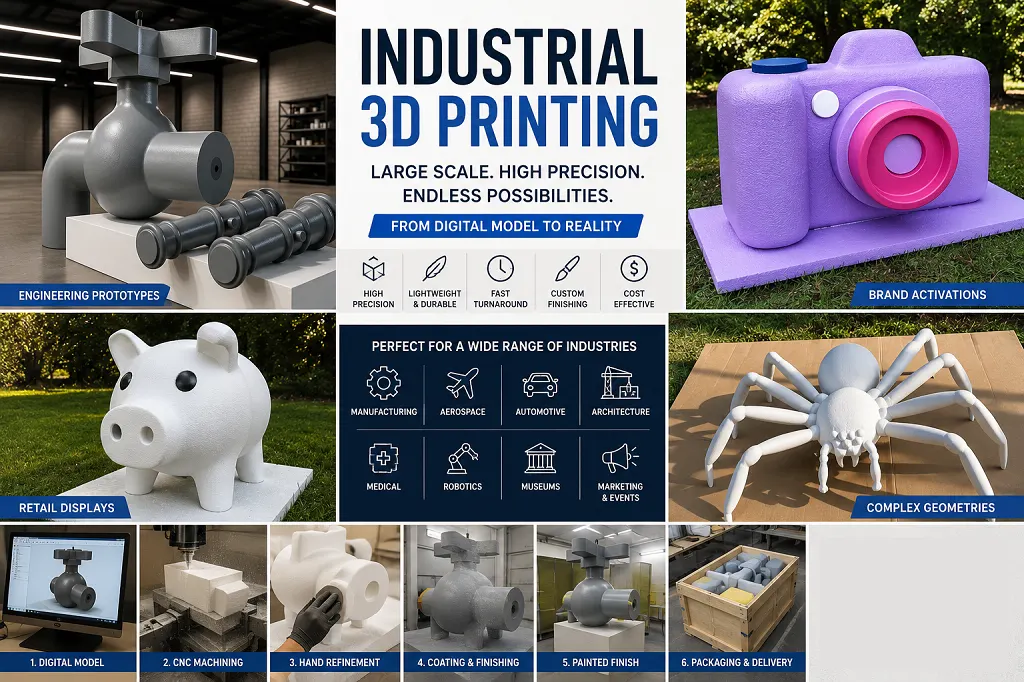
Industrial 3D Printing: Large-Scale Foam Prototypes, Models & Manufacturing Solutions
Our customer reviews
Read more reviewsRead more reviews