Roadside Signs for Business: How to Maximize Visibility from the Road
A gas station operator opening a new location on a state highway recently spent more time on sign placement than on almost any other single decision in the project. His site was set back 180 feet from the road edge, behind a slight rise that obscured the building itself from drivers approaching from the north. A sign at the property line would be visible; a sign any closer to the building would be invisible until a driver was already past the turn. After reviewing aerial photographs, traffic speed data, and the sightline geometry from both approach directions, he positioned a 32-foot pylon sign at the property line, sized specifically to be visible at the required reaction distance for a driver approaching at 55 mph. Six months after opening, his location was outperforming the company’s projections, and he attributed a significant share of the difference specifically to roadside sign visibility — the location wasn’t discoverable from passing traffic without it. Roadside sign strategy is exactly this kind of operational decision: not an aesthetic choice, but a visibility engineering problem with measurable consequences for business performance. This guide covers how to approach it correctly.
Why Roadside Signs Are Different from Other Business Signage
Most business signage is designed to communicate with people who are already in close proximity to the business — pedestrians on a sidewalk, visitors approaching an entrance, customers inside a retail environment. Roadside signs serve an entirely different audience: drivers moving at vehicle speed on a roadway, who have a few seconds to process a sign and make a navigation decision before passing the opportunity to turn.
Business signs that are effective in one context are frequently ineffective for roadside viewing. A beautifully detailed sign that communicates brand sophistication and service range at close range on a building facade may have too much information, too small a primary message, and too little contrast to be read from a moving vehicle at the distances and speeds that roadside viewing requires. Roadside sign design follows different rules — rules derived from the actual physics of vehicle-speed reading rather than from conventional sign aesthetics.
The core functional requirements of outdoor signs at roadside are three: the sign must be visible from a distance sufficient to allow a driver to slow and turn safely (this reaction distance depends on the posted speed limit and the road geometry); the primary message must be legible at that distance with letter heights appropriate to the viewing distance; and the information hierarchy must be limited to what a driver can process in the available viewing window. A roadside sign that checks all three boxes performs its job regardless of how simple or elaborate its design is; one that fails any of them fails as a roadside tool regardless of how visually impressive it may be.
Types of Roadside Signs and Their Applications
Pylon signs — tall freestanding sign structures with the sign cabinet elevated on a single pole — are the standard solution when maximum height is needed to achieve visibility over intervening vegetation, grade changes, competing structures, or to clear roadway sight-line obstructions. The pole elevation gives pylon signs early visual contact from approaching vehicles, and the single-pole construction creates a clean, unobstructed visual field around the sign face. Pylon signs are widely used at gas stations, fast food restaurants, hotels, and shopping centers specifically because their elevation makes them visible well in advance of the property, giving drivers adequate reaction distance at typical arterial road speeds.
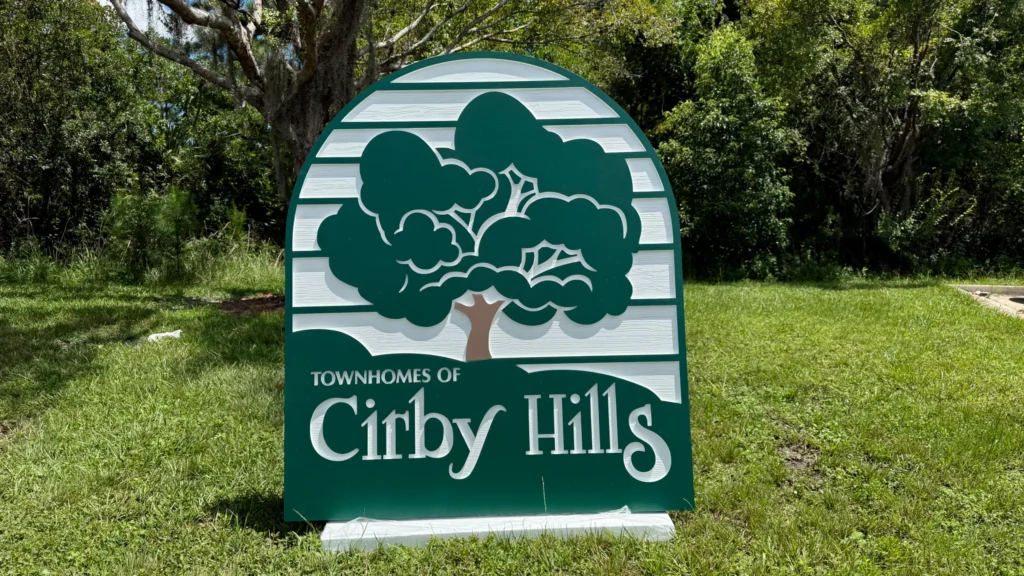
Monument signs positioned at roadway level are the appropriate choice when the sign location is at or near the property line along a roadway with adequate sight line from the primary approach direction, where elevation isn’t necessary for visibility. Monument signs communicate a higher level of permanence and brand quality than pylon signs at equivalent cost and are preferred for professional, medical, and office park applications where the premium-looking monument format is part of the intended brand communication.
Business signs outdoor on pole-and-panel systems — simpler than full pylon structures, using a two-post mounting with the sign panel between — serve roadside identification needs at lower cost than full pylon fabrication, with adequate visibility at lower speed limits or closer-to-road placement. These are common for smaller retail, service businesses, and roadside businesses along lower-speed commercial roads where the reduced height of a two-post system still provides adequate visibility.
Multi-tenant roadside signs — pylon or monument structures with panels for multiple businesses sharing a property — are standard for shopping centers, office parks, medical campuses, and any commercial property with multiple tenants requiring roadside identification. Tenant panel space allocation, updating capability when tenants change, and the relationship between the property identification element and individual tenant panels are the primary design considerations for these installations.
Sizing Roadside Signs for Your Location
Signs for businesses at roadside should be sized based on the viewing distance required at the posted speed limit — not based on any standard catalog size, and not based on what looks proportional at the installation location on foot. A sign that looks large while standing next to it is often actually too small for the roadside context it’s serving.
As a guideline widely used in sign industry specification: each inch of letter height provides approximately ten feet of comfortable reading distance at moderate lighting. A 12-inch letter height is readable at approximately 120 feet; a 24-inch letter height at approximately 240 feet. For a 55-mph roadway where a driver needs to read the sign and react (slow down, signal, and turn) within approximately 500 feet, the primary letter height of a roadside sign should be at least 30 to 40 inches to be comfortably readable at the required reaction distance.
Business signs outdoor also need to be evaluated against the visual competition at the specific location — adjacent roadside signs, directional signs, streetscape elements, and vegetation all compete for the same viewer attention. A sign that would be clearly visible on an uncongested rural road may be lost in visual noise on a commercial arterial with dense competing signage, requiring either higher mounting, greater illumination, or stronger color contrast to achieve equivalent visibility.
Permitting and Code Requirements
Every roadside sign installation is subject to local sign ordinances and in some cases state highway right-of-way regulations that govern maximum height, maximum sign area, setback from the roadway and property lines, illumination restrictions, and in some jurisdictions, design review requirements. These regulations vary enormously between municipalities and even between zoning districts within the same municipality.
Confirming applicable sign regulations before finalizing any roadside sign design is essential — a sign designed and fabricated without confirming local regulations may require modification after permitting review, adding cost and delay, or may be denied a permit entirely, requiring complete redesign. A sign company with experience in your specific municipality will know the applicable regulations and can guide the specification to produce a compliant design at the design stage rather than discovering compliance issues at permitting.
Frequently Asked Questions
What is a roadside sign and why is it important for business?
A roadside sign is exterior business signage positioned and sized specifically to be visible to drivers on an adjacent roadway, at the distances and speeds that allow them to react and turn safely. It’s important because for businesses whose customers primarily arrive by vehicle, the roadside sign is frequently the first — and sometimes the only — opportunity to make those potential customers aware of the business’s existence and location. A business with inadequate roadside visibility may attract only a fraction of its potential vehicle-traffic customer base regardless of its product or service quality.
How tall should a roadside sign be?
Roadside sign height should be determined by visibility requirements (the sign needs to clear any intervening vegetation, grade changes, or structures that would block the view from the roadway), local sign ordinances (which often specify maximum heights by zone and sign type), and business category conventions (gas station pylons and hotel signs typically need to be visible from greater distances than professional office signs). For pylon signs on high-speed arterials, heights of 25 to 50 feet are common; for monument signs at property line placement on lower-speed roads, 6 to 10 feet is typical.
Do roadside signs require permits?
Yes, virtually all roadside signs require building permits, and many also require approval under local sign ordinances that specify the sign program for a specific zoning district. Some locations along state and federal highways may also require permits from state departments of transportation for signs within the right-of-way or visible from the highway. Working with a sign company experienced in your specific location and permit jurisdiction is the most efficient way to navigate this process.
What information should a roadside sign display?
A roadside sign should display the minimum information necessary to identify the business and prompt the intended driver action — typically the business name or logo at large scale, and possibly a secondary identifier (the business category, a major brand affiliation, or a directional indicator) if the business name alone doesn’t communicate what the business is. Additional information — website, phone number, detailed service descriptions — is typically too small to read at roadside distances and should be reserved for close-range signage or digital channels.
Conclusion
The honest takeaway on roadside signs is that their effectiveness is an engineering problem before it’s a design problem. The right mounting height, the right letter size for the reading distance, the right amount of information for the available viewing window — these specifications determine whether the sign works as a roadside communication tool, independent of how refined or attractive the design itself is. Get the engineering right first, then execute the design within those parameters, and a roadside sign consistently delivers its core function: connecting the drivers who could be your customers to the physical location where you serve them.

Read more

The Importance of Hard Coating in Outdoor Signage: How Polyurea Coating Transforms Foam Structures into Durable Signage
The Art of Imitation: How Faux Finishes Transform EPS Foam Into Stone, Metal & Wood

Beyond Traditional Materials: Why HDU Foam Is Replacing Wood and Stone in High-End Signage

The Hidden Science Behind High-Quality Foam Lettering & Dimensional Signage

Eco-Friendly Signage Solutions: Is HDU & EPS Foam the Sustainable Choice?

Why Lightweight Foam Monument Signs Are Ideal for Large-Scale Signage

The Importance of Proper Installation for Monument Signs

Foam vs. Metal Signs: Cost, Durability, and Aesthetic Considerations

The Importance of Proper Installation for Monument Signs

From One-Time WOW to Multi-Tour ROI
Recommended Articles
HDU Signs: What High-Density Urethane Foam Is and Why It’s a Premium Sign Choice

Acrylic Signs for Business: Types, Benefits, and How to Choose the Right Style
Industrial 3D Printing: Large-Scale Foam Prototypes, Models & Manufacturing Solutions
Molds for Stone Signs: The Foundation Behind Consistent Architectural Signage

Beyond the Booth: How Custom 3D Displays Make Brands Stand Out at Expos and Events
Sandblasted vs. Routed Signs: Which Is Right for Your Project?
Our customer reviews
Read more reviewsRead more reviews