Foam Stage & Movie Props: The Hidden Art Behind Spectacular Entertainment Experiences
Quick Navigation
- The Business of Creating Illusions
- Why Entertainment Professionals Choose Foam
- Building Worlds Instead of Objects
- From Concept Art to Center Stage
- The Importance of Lightweight Construction
- Oversized Props for Maximum Impact
- Theater Productions and Scenic Design
- Theme Parks and Immersive Attractions
- Museum Exhibits and Educational Experiences
- Special Effects Without Special Effects
- The Future of Scenic Fabrication
- Conclusion
- Frequently Asked Questions
The audience gasps as a towering castle emerges from the darkness.
A giant ancient statue appears on stage.
A massive spaceship dominates the screen.
A mythical creature comes to life before thousands of spectators.
What audiences rarely realize is that many of these impressive structures share a common secret: they’re made from foam.
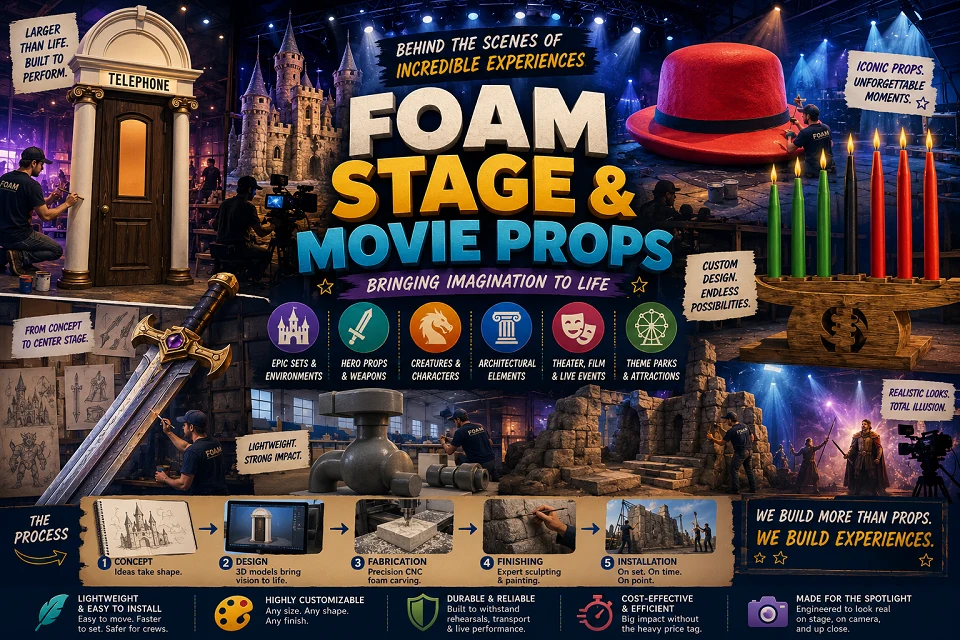
Behind some of the most memorable moments in theater productions, film sets, theme parks, live events, museums, and television productions lies a fabrication process that combines artistry, engineering, and creativity. Foam stage and movie props have become an essential part of modern entertainment because they allow production teams to build extraordinary worlds without the limitations associated with traditional construction materials.
From oversized props and scenic backdrops to realistic architectural facades and fantasy environments, foam fabrication helps transform imagination into reality.

The Business of Creating Illusions
Entertainment is built on illusion.
Audiences willingly suspend disbelief to immerse themselves in stories, experiences, and environments that transport them somewhere new.
To achieve that illusion, production designers need materials that can replicate virtually anything imaginable.
Ancient stone ruins.
Futuristic spacecraft.
Giant books.
Medieval castles.
Massive sculptures.
Fantasy landscapes.
The challenge is making these elements look authentic while remaining practical for production schedules, transportation requirements, budgets, and safety considerations.
This is where foam fabrication excels.
Why Entertainment Professionals Choose Foam
Film and stage productions operate under unique constraints.
Sets must often be:
- Built quickly
- Moved efficiently
- Installed safely
- Modified easily
- Budget-conscious
- Visually convincing
Heavy construction materials can create logistical challenges that slow production and increase costs.
Foam offers an alternative.
Its lightweight properties allow fabricators to create large-scale scenic elements that appear substantial while remaining manageable throughout production.
For touring productions and live events, this flexibility becomes particularly valuable.
Building Worlds Instead of Objects
Many people think of props as individual objects.
In reality, modern scenic fabrication often involves creating entire environments.
A production may require:
Architectural Facades
Buildings, castles, temples, and city streets that create immersive settings.
Scenic Landscapes
Mountains, cliffs, caves, and rock formations that establish atmosphere and scale.
Hero Props
Large signature pieces that become focal points within a production.
Set Extensions
Custom-built elements that expand physical environments and support visual storytelling.
Interactive Scenic Features
Structures designed for performer interaction and audience engagement.
The goal is not simply to build objects but to create believable worlds.
From Concept Art to Center Stage
Every successful scenic element begins as an idea.
The process typically starts with sketches, storyboards, digital renderings, or production design concepts.
Once approved, the project moves through several stages.
Design Development
Concepts are translated into detailed production-ready models.
Digital Modeling
Three-dimensional files help establish proportions, structural requirements, and fabrication strategies.
CNC Fabrication
Precision machinery transforms digital concepts into physical forms with remarkable accuracy.
Assembly
Individual components are joined together to create larger scenic structures.
Scenic Finishing
Artists apply textures, coatings, paint systems, and special effects that bring the illusion to life.
Installation
The completed pieces are transported and integrated into the final production environment.
What begins as a drawing ultimately becomes a physical experience for audiences.
The Importance of Lightweight Construction
One of foam’s greatest advantages is its weight—or more accurately, its lack of it.
Large scenic pieces may appear massive, but lightweight construction provides significant benefits.
Faster Installation
Production crews can move and position pieces more efficiently.
Improved Safety
Reduced weight minimizes handling risks and structural concerns.
Easier Transportation
Large elements become more practical to ship between locations.
Touring Flexibility
Traveling productions benefit significantly from reduced transportation costs.
For theaters, touring companies, and event organizers, these advantages can have a major impact on project efficiency.
Movie Props That Look Like the Real Thing
Film audiences have incredibly high expectations.
Modern cameras capture extraordinary detail, leaving little room for visual shortcuts.
As a result, scenic fabrication often requires realistic finishes that convincingly replicate other materials.
Professional finishing techniques can recreate the appearance of:
- Stone
- Concrete
- Marble
- Wood
- Metal
- Ice
- Rock
- Brick
Most viewers never realize what lies beneath the surface.
The illusion is complete.
Oversized Props for Maximum Impact
Many productions intentionally play with scale.
A giant key.
An oversized treasure chest.
A massive book.
A larger-than-life piece of equipment.
These props create dramatic visual moments while reinforcing storytelling themes.
Because foam can be fabricated into virtually any shape, designers gain tremendous creative freedom when developing oversized scenic elements.
The only real limit becomes imagination.
Theater Productions and Scenic Design
Theater presents unique fabrication challenges.
Unlike film, where camera angles can conceal certain details, stage productions must maintain the illusion from multiple audience perspectives.
Scenic elements often need to:
- Withstand repeated performances
- Support fast scene changes
- Remain visually convincing from a distance
- Integrate with lighting systems
- Accommodate performer interaction
Foam fabrication provides flexibility that helps designers meet these requirements while maintaining artistic vision.
Theme Parks and Immersive Attractions
Theme parks represent some of the most ambitious scenic environments ever created.
Guests expect complete immersion.
Every structure, sculpture, and decorative feature contributes to the overall experience.
Foam fabrication is frequently used to create:
- Rock formations
- Fantasy architecture
- Themed environments
- Character displays
- Decorative landscapes
- Attraction facades
The ability to create large-scale elements without excessive weight makes foam particularly valuable for themed entertainment projects.
Museum Exhibits and Educational Experiences
Museums increasingly utilize immersive exhibits to engage visitors.
Custom scenic fabrication helps bring history, science, culture, and storytelling to life.
Examples include:
- Historical recreations
- Archaeological displays
- Interactive exhibits
- Educational environments
- Replica artifacts
These installations allow visitors to experience concepts visually rather than simply reading about them.
Special Effects Without Special Effects
Not every visual effect requires digital technology.
Many productions continue relying on practical effects because they create authentic physical experiences.
Custom-fabricated foam elements often serve as:
- Creature components
- Scenic enhancements
- Environmental effects
- Interactive props
- Large-scale visual features
Practical fabrication remains a valuable complement to digital production technologies.
The Future of Scenic Fabrication
Entertainment experiences continue evolving.
Audiences expect larger, more immersive, and more interactive environments than ever before.
Emerging trends include:
Hybrid Physical-Digital Experiences
Combining physical scenic fabrication with projection mapping and digital effects.
Interactive Environments
Scenic elements that respond to audience participation.
Experiential Entertainment
Immersive attractions that blur the line between performance and environment.
Advanced CNC Technology
Increasingly complex designs produced with greater efficiency and precision.
As entertainment continues pushing creative boundaries, foam fabrication will remain a critical tool for bringing ambitious visions to life.
Conclusion
Every memorable production relies on countless creative decisions that audiences rarely see.
Behind towering castles, ancient ruins, futuristic environments, oversized props, and immersive scenic experiences lies a fabrication process designed to turn imagination into reality.
Foam stage and movie props offer a unique combination of creative flexibility, lightweight construction, scalability, and visual realism that makes them indispensable across the entertainment industry.
Whether supporting a blockbuster film, a Broadway-style production, a touring concert, a museum exhibit, or a theme park attraction, foam fabrication helps create the unforgettable moments that audiences remember long after the curtain falls.
In the world of entertainment, the most convincing illusions often begin with a simple block of foam.
Frequently Asked Questions
What are foam stage props used for?
Foam stage props are commonly used in theater productions, concerts, live events, theme parks, museums, television productions, and film sets.
Why is foam popular in scenic fabrication?
Foam is lightweight, customizable, easy to transport, cost-effective, and capable of achieving highly detailed finishes.
Can foam props look like stone or metal?
Yes. Professional scenic finishing techniques can accurately replicate the appearance of stone, metal, wood, concrete, and many other materials.
Are foam props durable enough for repeated use?
Properly fabricated and finished foam props can withstand repeated handling, transportation, and performance schedules.
What types of productions use foam scenic elements?
Film studios, theaters, touring productions, museums, theme parks, experiential marketing agencies, and event companies regularly utilize foam scenic fabrication.

Read more

The Importance of Hard Coating in Outdoor Signage: How Polyurea Coating Transforms Foam Structures into Durable Signage
The Art of Imitation: How Faux Finishes Transform EPS Foam Into Stone, Metal & Wood

Beyond Traditional Materials: Why HDU Foam Is Replacing Wood and Stone in High-End Signage
The Hidden Science Behind High-Quality Foam Lettering & Dimensional Signage
Eco-Friendly Signage Solutions: Is HDU & EPS Foam the Sustainable Choice?

Why Lightweight Foam Monument Signs Are Ideal for Large-Scale Signage

The Importance of Proper Installation for Monument Signs

Foam vs. Metal Signs: Cost, Durability, and Aesthetic Considerations

The Importance of Proper Installation for Monument Signs

From One-Time WOW to Multi-Tour ROI
Recommended Articles
HDU Signs: What High-Density Urethane Foam Is and Why It’s a Premium Sign Choice
Acrylic Signs for Business: Types, Benefits, and How to Choose the Right Style
Industrial 3D Printing: Large-Scale Foam Prototypes, Models & Manufacturing Solutions
Molds for Stone Signs: The Foundation Behind Consistent Architectural Signage
Beyond the Booth: How Custom 3D Displays Make Brands Stand Out at Expos and Events
Sandblasted vs. Routed Signs: Which Is Right for Your Project?
Our customer reviews
Read more reviewsRead more reviews