Advanced Mold Fabrication for Faux Stone Monument Signs
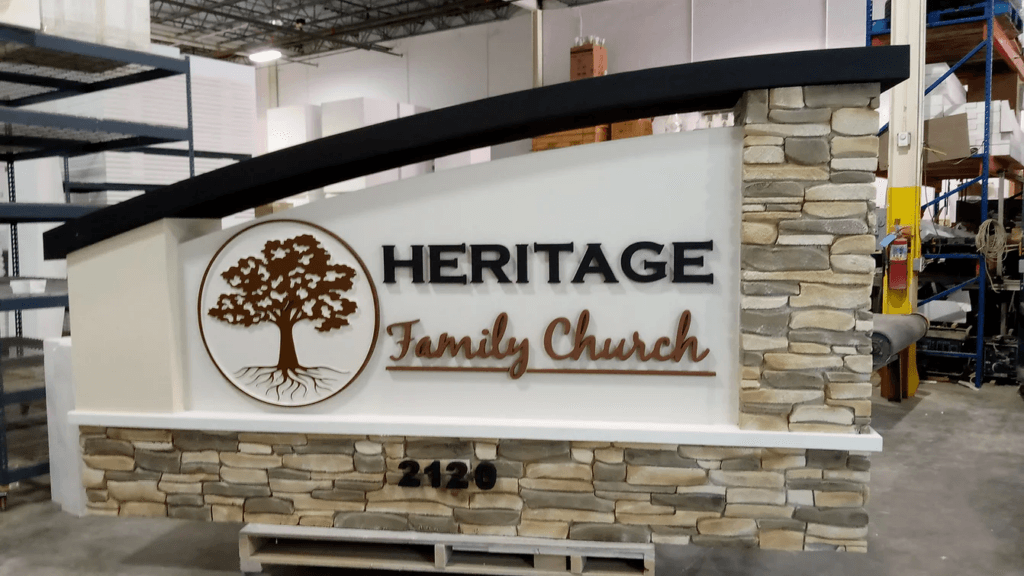
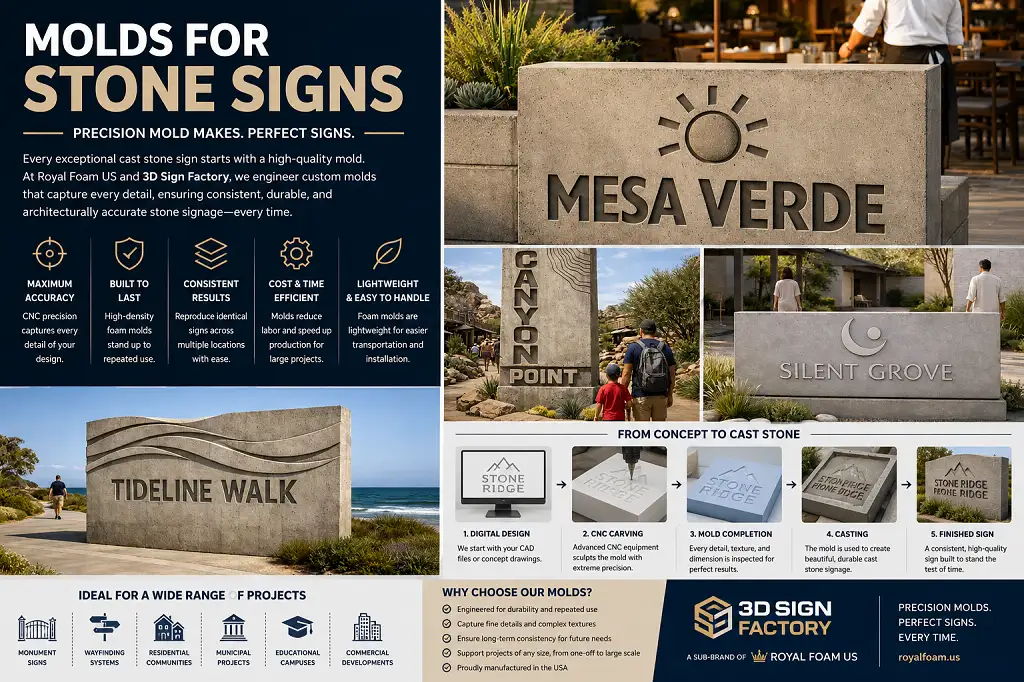
Molds for stone signs play a critical role in modern architectural sign manufacturing, especially in projects requiring consistent reproduction of stone textures, masonry details, carved surfaces, and dimensional architectural features. In commercial signage, residential developments, themed environments, parks, resorts, and monument construction, molds allow manufacturers to achieve repeatable texture accuracy and controlled production quality across multiple sign structures.

As architectural signage becomes more detailed and visually sophisticated, consistency becomes increasingly important. Developers, sign companies, contractors, and property owners expect monument signs and architectural features to maintain the same appearance across multiple locations and production cycles. This is where professionally fabricated molds become an essential part of the manufacturing process.
Stone sign molds are used to reproduce:
- Faux stone textures
- Brick patterns
- Rock surfaces
- Architectural caps
- Carved borders
- Decorative trim details
- Masonry block appearances
- Sculptural textures
- Dimensional architectural elements
These molds allow repeated fabrication without requiring each sign to be individually hand-sculpted from scratch.
From a manufacturing perspective, mold production begins with digital engineering and pattern development. Surface geometry, texture depth, transition lines, grout spacing, and dimensional detail are carefully planned before fabrication begins. This stage is especially important because molds directly control the final visual quality of the architectural surface.
In modern fabrication, master patterns are often created using CNC technology capable of producing highly accurate textures and dimensional surfaces. Precision CNC shaping allows stone patterns, carved details, and architectural forms to be engineered with repeatable consistency while maintaining natural visual variation.
Once the master pattern is complete, molds are produced to capture every detail of the original surface. These molds become reusable production tools capable of reproducing the same architectural appearance across multiple projects or multiple sign units within the same development.
One of the biggest advantages of mold-based production is consistency. In large commercial or residential developments, multiple monument signs may be required throughout the property. Without mold fabrication, maintaining exact texture and pattern alignment across all signs becomes extremely difficult.
Professionally fabricated molds ensure:
- Consistent stone appearance
- Uniform texture depth
- Matching grout patterns
- Repeatable dimensional details
- Controlled architectural quality
This level of repeatability is especially valuable for:
- HOA communities
- Apartment developments
- Franchise locations
- Resorts
- Municipal projects
- Campus signage programs
- Multi-entrance properties
From a visual standpoint, faux stone monument signs rely heavily on texture realism. The goal is not simply to create random surface roughness, but to reproduce believable stone geometry, natural transitions, and authentic architectural character.
Molds help achieve this by capturing subtle details such as:
- Chiseled edges
- Layered stone transitions
- Split-face textures
- Mortar lines
- Surface imperfections
- Rock grain variation
These details contribute significantly to the final realism of the monument sign.
Another major advantage of mold fabrication is production efficiency. Once a mold is created, complex textures can be reproduced repeatedly without requiring manual recreation of the same surface. This improves consistency while reducing fabrication variability between projects.
From an engineering perspective, mold design must also account for production practicality. Texture depth, release angles, dimensional transitions, and material behavior all affect how effectively the mold performs during manufacturing. Poorly designed molds can create distortion, trapped material, weak edges, or inconsistent texture reproduction.
Material selection for mold production is also important. Molds must maintain dimensional stability while withstanding repeated use throughout the fabrication process. High-quality molds are designed to preserve fine detail while remaining durable enough for long production cycles.
Architecturally, stone sign molds allow monument signs to integrate naturally into surrounding environments. Faux stone textures are commonly used to complement:
- Residential developments
- Clubhouses
- Parks
- Golf communities
- Hotels and resorts
- Commercial centers
- Municipal architecture
- Landscape design features
This helps monument signage feel like part of the architecture rather than a separate standalone object.
Another important advantage is scalability. Mold-based fabrication allows manufacturers to create:
- Single custom monuments
- Repeating sign packages
- Multi-location architectural signage
- Coordinated property branding
- Large dimensional stone-texture installations
Because the textures are digitally engineered and mold-reproduced, consistency can be maintained even across large production runs.
From a cost perspective, molds also improve long-term production efficiency. While master pattern development requires precision engineering and fabrication time, reusable molds significantly reduce the complexity of reproducing architectural textures in future projects. This becomes especially valuable for developments requiring multiple matching signs or phased construction schedules.
In addition to monument signs, molds are also commonly used for:
- Faux rock fabrication
- Architectural foam details
- Decorative wall panels
- Themed environments
- Sculptural installations
- Landscape features
- Architectural branding elements
This flexibility makes mold fabrication an important part of modern dimensional manufacturing workflows.
Durability and detail retention remain critical throughout the entire process. Professionally engineered molds are designed to maintain texture integrity and dimensional consistency through repeated production cycles while preserving the realism required for high-end architectural applications.
In today’s architectural signage industry, molds for stone signs represent far more than simple production tools. They are precision-engineered fabrication assets that allow manufacturers to combine repeatability, efficiency, texture realism, and architectural consistency across complex monument sign projects.
For sign companies, developers, architects, contractors, and fabrication specialists, professionally produced molds provide a scalable solution for achieving high-quality faux stone architectural signage with consistent long-term results.

Read more

The Importance of Hard Coating in Outdoor Signage: How Polyurea Coating Transforms Foam Structures into Durable Signage
The Art of Imitation: How Faux Finishes Transform EPS Foam Into Stone, Metal & Wood

Beyond Traditional Materials: Why HDU Foam Is Replacing Wood and Stone in High-End Signage

The Hidden Science Behind High-Quality Foam Lettering & Dimensional Signage
Eco-Friendly Signage Solutions: Is HDU & EPS Foam the Sustainable Choice?

Why Lightweight Foam Monument Signs Are Ideal for Large-Scale Signage

The Importance of Proper Installation for Monument Signs

Foam vs. Metal Signs: Cost, Durability, and Aesthetic Considerations

The Importance of Proper Installation for Monument Signs

From One-Time WOW to Multi-Tour ROI
Recommended Articles
HDU Signs: What High-Density Urethane Foam Is and Why It’s a Premium Sign Choice

Acrylic Signs for Business: Types, Benefits, and How to Choose the Right Style
Industrial 3D Printing: Large-Scale Foam Prototypes, Models & Manufacturing Solutions
Molds for Stone Signs: The Foundation Behind Consistent Architectural Signage
Beyond the Booth: How Custom 3D Displays Make Brands Stand Out at Expos and Events
Sandblasted vs. Routed Signs: Which Is Right for Your Project?
Our customer reviews
Read more reviewsRead more reviews