
Monument Signs for Commercial Properties – Design, Materials, Durability, and Customization Options
Picture this. You’ve just signed a lease on a commercial property, the interior buildout looks great, your staff is ready, and you’re two weeks from opening. Then someone asks: how will people actually find you? Not on Google Maps – in real life, from the road, at 40 miles per hour. That’s when monument signs stop being an afterthought and start being an urgent priority.
Monument signs are ground-level structures that identify a business or property from the street. Unlike pole signs that hang overhead or wall-mounted signs that only work once someone is already close, a monument sign sits at eye level, anchored to the ground, often right at your entry point. It’s the first physical thing most customers will see before they ever reach your front door. Get it right and it does quiet, constant work for your brand every single day. Get it wrong – or skip it entirely – and you’re relying on people to already know where you’re going.
This article covers what actually goes into a commercial monument sign: how they’re designed, what materials hold up over time, what customization looks like in practice, and what you should know before you start the process.

Design – What Makes a Monument Sign Work
Design is where most businesses either set themselves up for success or quietly undermine it. A monument sign isn’t just a logo on a box. It’s an architectural element that has to work at distance, in variable light, across different seasons, and against whatever background sits behind it – trees, traffic, other buildings, sky.
The first decision is scale. Monument signs range from small, low-profile markers around 3 feet tall to large monument signs that stand 8 to 10 feet high and stretch 15 or more feet wide. The right size depends on your setback from the road, your speed limit corridor, and local zoning ordinances. A sign that looks impressive in a design mockup can disappear completely if the road in front of your property has a 55 mph speed limit and the sign is only 4 feet tall. You need a sign that registers before a driver has already passed your entrance.
Letter height is part of this equation. A general rule of thumb used in the signage industry: for every 10 feet of viewing distance, you need roughly 1 inch of letter height for comfortable readability. So if your entry is 100 feet from the road, you’re looking at a minimum of 10-inch letters. Most commercial properties need larger than that.
Monument sign design also involves hierarchy – what information goes where, and how much of it. Business name, suite numbers, logo, tagline, address. Not all of these belong on the same sign. Cluttered monument signage reads as noise. Drivers don’t stop to decode a busy layout. The most effective designs lead with one strong visual element, usually the business name or logo, and keep everything else secondary.
Color contrast matters more than most people expect. Dark letters on a light background, or vice versa, dramatically outperforms same-tone combinations even when those combinations look elegant in a design presentation. That’s why a lot of architectural monument signs use a neutral stone or stucco base with high-contrast dimensional lettering rather than etched or recessed text that blends into the surface.
Lighting is another layer. Illuminated monument signs – either externally lit with ground-mounted fixtures or internally lit with LED backlighting – extend your sign’s working hours into the evening and early morning. If your business is open past dark, or if your property has significant traffic during commute hours, an unlit sign is leaving visibility on the table.
Materials – What Monument Signs Are Actually Made Of
Walk up to a monument sign and knock on it. You might be surprised. Some are solid masonry. Some are steel frames with stucco finishes. Some are high-density foam with a hard coat that mimics stone so convincingly you’d never know. The material choice affects cost, weight, installation complexity, maintenance, and how the sign holds up 10 years from now.
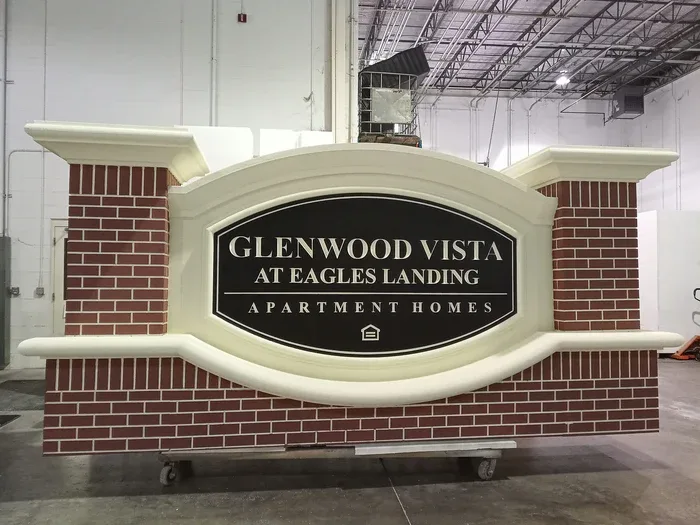
Masonry and brick monument signs are the traditional standard. They’re genuinely heavy, genuinely durable, and they communicate permanence in a way that other materials don’t quite match. A brick monument sign at the entrance to an office park or a medical campus signals that the property has been there a while and intends to stay. The downside is cost and flexibility – masonry is expensive to build and nearly impossible to modify once it’s done. If your tenants change or your branding shifts, you’re working around the structure, not changing it.
Concrete block with stucco finish is a step more flexible. The core is structural, but the finished surface can be painted, retextured, or refinished without tearing down the whole sign. This is a common choice for commercial monument signs that need to balance durability with some ability to update the look over time.
Foam monument signs are worth understanding properly because they’re often dismissed without reason. High-density urethane foam – specifically the kind used in architectural signage – can be carved and shaped into forms that would be prohibitively expensive in stone or masonry. The foam itself isn’t fragile. With a hard coat finish applied over the surface, foam monument signs resist moisture, UV exposure, and impact at a level that surprises most people who haven’t worked with the material. They’re significantly lighter than masonry, which simplifies installation and reduces the structural requirements of the base. And because foam can be shaped precisely, it’s a practical choice for complex architectural monument signs with curved profiles, layered elements, or detailed relief work.
Steel and aluminum frames with applied finishes sit in the middle ground. They’re lighter than masonry, more weather-resistant than untreated wood, and they accept a wide range of surface treatments – powder coating, painted finishes, brushed metal faces. HDR (high-density resin) panels are often used as face materials on these structures.
Whatever the primary structure, the face of the sign – the part that carries your actual name and graphics – is usually a separate component. Dimensional letters, acrylic panels, routed aluminum, or digital displays can be mounted to nearly any sign structure. That separation between structure and face is what makes updating signage possible without replacing the entire monument.

Durability – What Actually Holds Up Outdoors
Outdoor monument signs live in a punishing environment. Sun, rain, freeze-thaw cycles, wind, humidity, UV radiation, and occasionally a poorly aimed landscaping vehicle. Durability isn’t just about the material – it’s about how the whole system is built, finished, and maintained.
UV degradation is the quiet killer of outdoor signs. Colors fade, plastics yellow, and painted surfaces chalk and peel when they’re not specified for exterior use. The difference between an interior-grade finish and a proper exterior coating isn’t subtle over time – it’s the difference between a sign that still looks sharp at year 7 and one that looks neglected by year 3. Quality monument signage companies use exterior-grade paints, UV-stabilized acrylics, and powder-coated metals specifically because those materials hold color and finish integrity under sustained sun exposure.
Moisture management is the other critical factor. Water that gets into a sign structure – through cracks, gaps around lettering, or inadequate sealing at the base – causes problems that compound over time. Wood substrates rot. Metal frames rust from the inside. Foam can delaminate from its hard coat if moisture gets between layers. Proper monument sign installation includes sealing all penetrations, using appropriate caulks and gaskets, and ensuring the base doesn’t trap standing water against the structure.
Concrete and masonry bases need proper footings. In climates with freezing temperatures, a footing that doesn’t extend below the frost line will heave and shift as the ground freezes and thaws. A shifting base cracks the sign structure above it and creates drainage problems that accelerate deterioration. This is one of the reasons monument sign installation should be handled by contractors familiar with local soil and climate conditions – not just general contractors who’ve never dealt with signage-specific requirements.
Illuminated signs add electrical components that need their own durability consideration. LED modules have dramatically longer service lives than older fluorescent or neon components – typically 50,000 hours or more – but they still need to be installed in properly sealed enclosures. Moisture intrusion into a sign cabinet will cause LED failures, wiring corrosion, and eventually a dark sign that looks worse than no sign at all.
Maintenance is honest work. Even a well-built outdoor monument sign benefits from periodic inspection – checking sealants, cleaning the face, touching up any paint chips before they allow moisture in, and verifying that lighting components are functioning. A sign that gets this basic attention will hold up for 15 to 20 years without major issues. One that gets ignored will show its age in half that time.
Customization – Matching the Sign to Your Property and Brand
Custom monument signs are not a luxury category. They’re the practical answer to the fact that no two commercial properties have exactly the same setback, zoning constraints, architectural style, branding requirements, and budget. A sign that works perfectly for a medical office complex would look wrong at a retail strip center and completely out of place at a luxury apartment entrance.
The customization process starts with site conditions. A monument signage company worth working with will want to know your property’s road frontage, the distance from the sign location to the nearest travel lane, your local sign code requirements, and what the background environment looks like – what’s behind the sign from a driver’s perspective. These aren’t administrative details. They directly shape what size, shape, and finish will actually perform.
Branding integration is where monument signs get genuinely interesting. If your business has established brand standards – specific colors, fonts, logo treatment – those need to translate to a three-dimensional, outdoor-scaled format without losing their integrity. A logo that works beautifully on a business card or a website doesn’t automatically translate to a 6-foot sign face. Good sign design involves adapting brand elements for the medium, not just scaling them up. That might mean simplifying a complex logo, adjusting color values for exterior visibility, or choosing a letter style that reads clearly at distance even if it’s slightly different from the brand’s standard typeface.
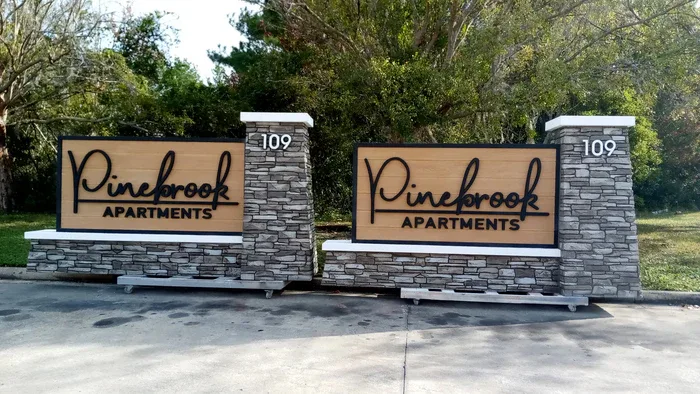
Multi-tenant properties add another layer. Office parks, retail centers, and medical campuses often need entry monument signs that identify the property itself while also accommodating tenant panels – individual name inserts that can be swapped out as tenants change. This is a design and construction decision that needs to be made upfront, because a sign built for a single identity is structurally different from one built to accept interchangeable panels. Tenant panel systems use standardized frame sizes and mounting systems so that adding, removing, or replacing a panel doesn’t require modifying the main structure.
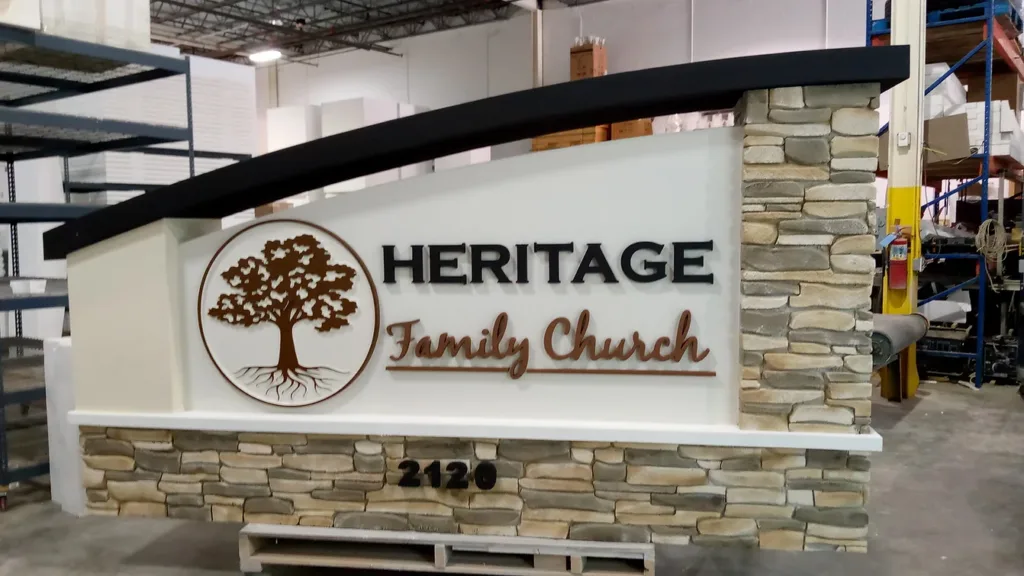
Architectural monument signs – the category that most closely mirrors the style and materials of the building itself – are particularly common in high-end commercial and institutional settings. A medical campus with a stone-clad building naturally calls for a monument sign that uses similar stone veneer or a finish that references it. A modern glass-and-steel office building might call for a monument sign with clean geometric lines, brushed metal lettering, and minimal ornamentation. Getting this right isn’t about matching exactly – it’s about making the sign feel like it belongs to the same design family as the property it represents.
Budget shapes customization, and it’s worth being direct about that. A fully custom masonry monument sign with dimensional illuminated letters, stone veneer, and integrated landscaping can run from $15,000 to $50,000 or more depending on size and complexity. A well-executed foam monument sign with a hard coat finish and quality face graphics can achieve a very similar visual result for a fraction of that cost. Neither option is inherently better – the right choice depends on your budget, your timeline, how long you expect to be at the location, and whether the sign needs to match existing site structures.
Frequently Asked Questions
What is a monument sign?
A monument sign is a ground-level sign structure used to identify a business, building, or property. Unlike pole signs or wall signs, it sits close to grade – usually at or near the entrance to a property – and is self-supporting, anchored directly to the ground or a concrete base. Most commercial monument signs are between 3 and 10 feet tall.
Why are monument signs important for businesses?
They solve a visibility problem that no other sign type addresses as well. A monument sign at your property entrance tells drivers where to turn before they’ve passed your driveway. It also creates a professional, established impression – a business with a well-built entry sign reads as more credible and permanent than one without any ground-level identification.
Are foam monument signs durable enough for outdoor use?
Yes, when they’re built correctly. High-density urethane foam with a proper hard coat exterior finish handles UV exposure, moisture, and temperature changes well. The foam itself isn’t the weak point – the finish system and how well the sign is sealed and installed determine long-term performance. Many foam monument signs in commercial settings have been in service for 10 to 15 years without significant deterioration.
Can monument signs be fully customized to match my branding?
Fully, yes. Size, shape, color, finish, lettering style, logo treatment, illumination, and material can all be specified to match your brand standards and the architectural character of your property. The practical limits are your local sign code – which regulates height, area, and setback – and your budget. Within those constraints, custom monument signs can be built to nearly any specification.
One honest takeaway: a monument sign is infrastructure, not decoration. The businesses that treat it that way – planning it early, specifying it properly, and building it to last – get a sign that works for them for 15 years or more. The ones that rush it or cut corners end up replacing it, or worse, living with something that undersells their property every single day.

Read more
The Importance of Hard Coating in Outdoor Signage: How Polyurea Coating Transforms Foam Structures into Durable Signage
The Art of Imitation: How Faux Finishes Transform EPS Foam Into Stone, Metal & Wood
Beyond Traditional Materials: Why HDU Foam Is Replacing Wood and Stone in High-End Signage
The Hidden Science Behind High-Quality Foam Lettering & Dimensional Signage
Eco-Friendly Signage Solutions: Is HDU & EPS Foam the Sustainable Choice?

Why Lightweight Foam Monument Signs Are Ideal for Large-Scale Signage
The Importance of Proper Installation for Monument Signs

Foam vs. Metal Signs: Cost, Durability, and Aesthetic Considerations

The Importance of Proper Installation for Monument Signs
From One-Time WOW to Multi-Tour ROI
Recommended Articles
Industrial 3D Printing: Large-Scale Foam Prototypes, Models & Manufacturing Solutions
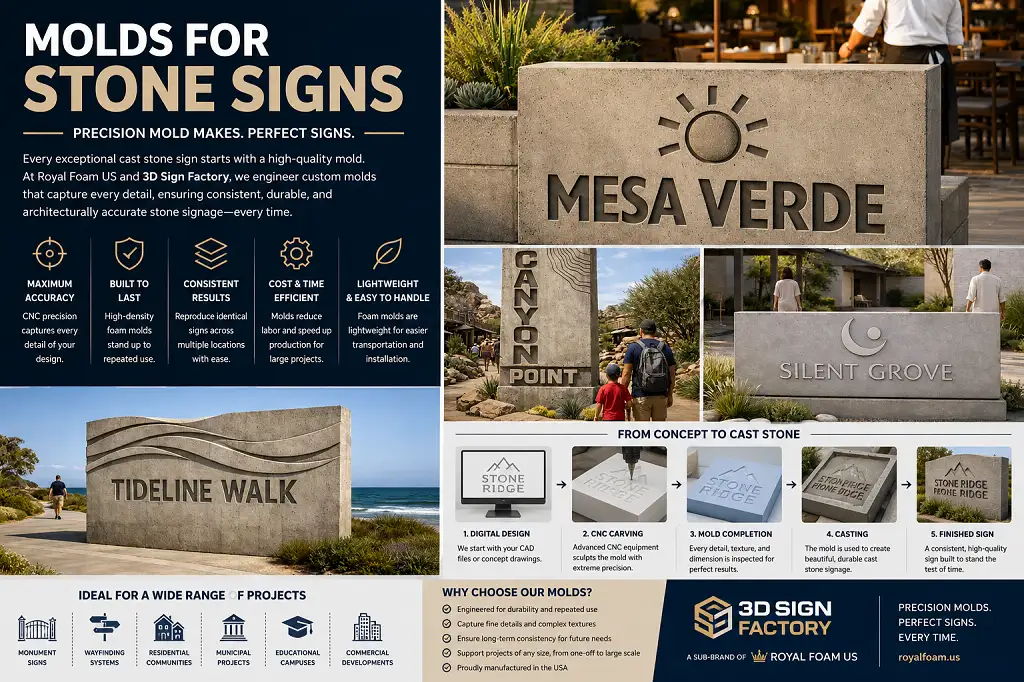
Molds for Stone Signs: The Foundation Behind Consistent Architectural Signage
Beyond the Booth: How Custom 3D Displays Make Brands Stand Out at Expos and Events
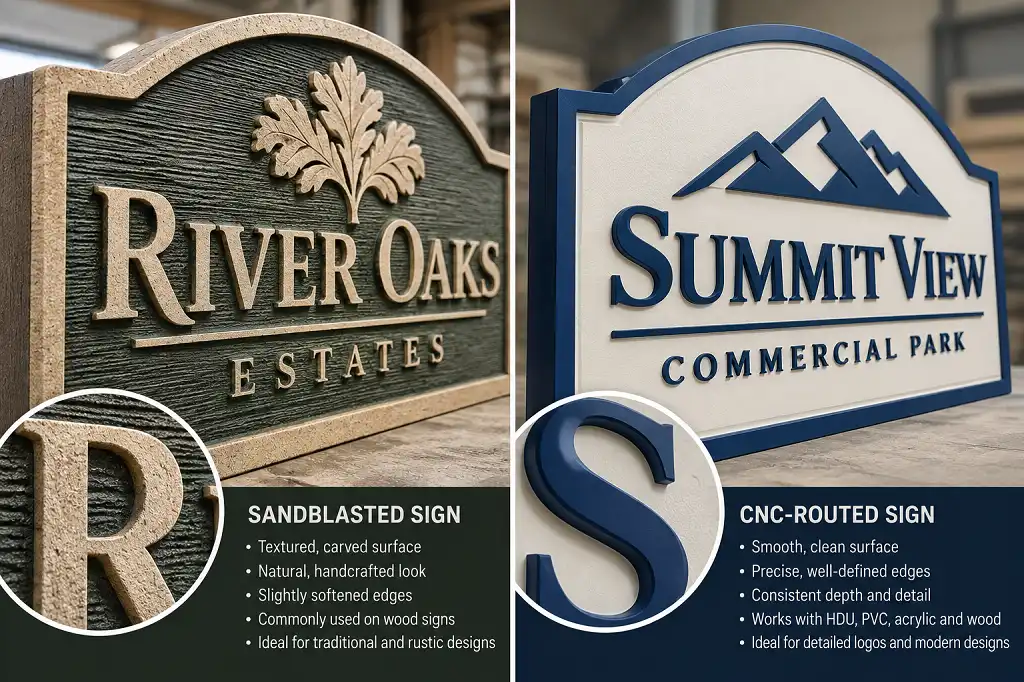
Sandblasted vs. Routed Signs: Which Is Right for Your Project?

Letter Signs: How Dimensional Letter Signage Works for Every Business Type

Restaurant Signs and Menu Boards: How to Brand Your Dining Establishment
Our customer reviews
Read more reviewsRead more reviews