Molds for Stone Signs: The Foundation Behind Consistent Architectural Signage
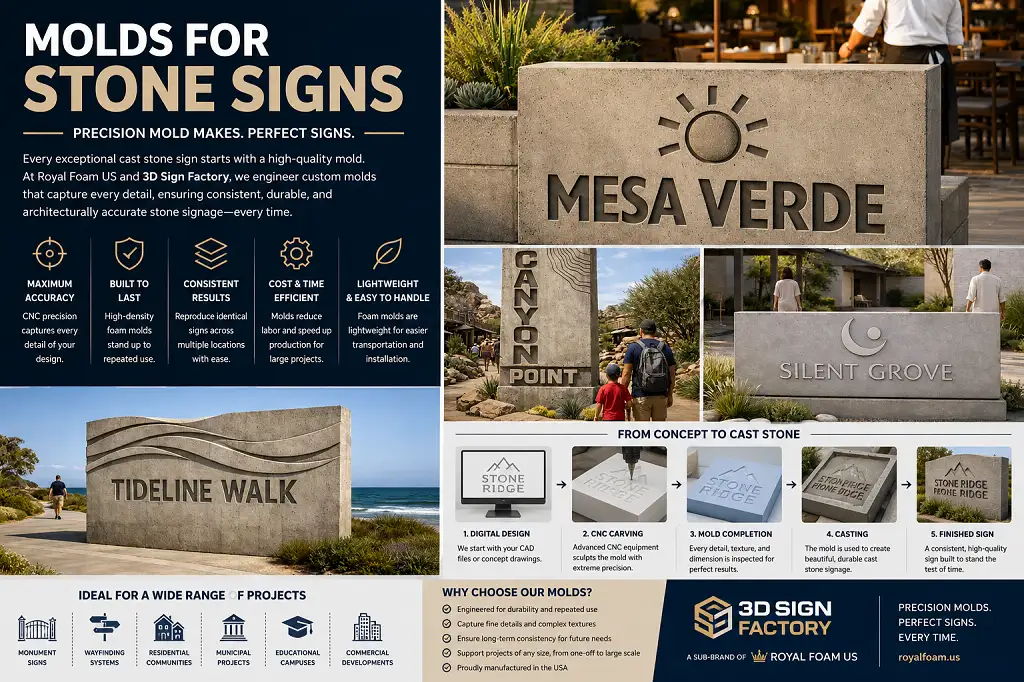
When people admire a cast stone monument sign, they usually notice the finished product: the texture, craftsmanship, dimensional details, and architectural appearance.
What they rarely see is the component that makes all of it possible: the mold.
In the world of cast stone signage, molds are where precision begins. They determine the accuracy, consistency, texture, and repeatability of every finished sign. Whether producing a single custom monument or hundreds of matching community signs, the quality of the mold directly impacts the quality of the final product.
At 3D Sign Factory, custom molds are engineered using advanced CNC technology, high-density foam fabrication, and precision manufacturing techniques that allow architectural stone signage to be reproduced accurately and efficiently.
Why Molds Matter
A stone sign may only be installed once, but the mold behind it may be used dozens, or even hundreds, of times.
The mold serves as the master pattern that captures every detail of a design, including:
- Lettering
- Logos
- Textures
- Decorative borders
- Stone patterns
- Architectural elements
Without a properly engineered mold, even the best casting materials cannot achieve consistent results.
Simply put: the mold is the blueprint of the finished sign.
From Digital Design to Physical Reality
Every mold begins with a digital design.
Using CAD software and CNC machining technology, designers transform a concept into a highly accurate physical model.
This process allows:
- Precise dimensions
- Clean lettering
- Consistent depth
- Accurate texture reproduction
- Repeatable production
Unlike traditional hand-carved methods, modern CNC fabrication ensures that every detail is reproduced exactly as intended.
Why Foam Is Ideal for Mold Production
High-density foam has become one of the most effective materials for creating molds used in cast stone signage.
Foam offers several advantages:
- Lightweight handling
- Easy machining
- Exceptional detail reproduction
- Fast production timelines
- Lower manufacturing costs
Using advanced CNC equipment, even highly detailed logos, stone textures, and custom architectural features can be carved directly into foam patterns with remarkable accuracy.
Consistency Across Multiple Locations
Many developments require more than one sign.
Master-planned communities, apartment complexes, commercial properties, universities, and municipalities often need matching signage installed across multiple locations.
Custom molds allow manufacturers to produce:
- Identical monument signs
- Matching wayfinding systems
- Consistent branding elements
- Standardized architectural features
This ensures every installation maintains the same appearance regardless of production quantity.
Architectural Textures and Custom Detailing
One of the biggest advantages of modern mold fabrication is the ability to reproduce complex textures.
Molds can incorporate:
- Natural stone patterns
- Split-face textures
- Brick appearances
- Wood grain details
- Custom decorative elements
- Architectural reliefs
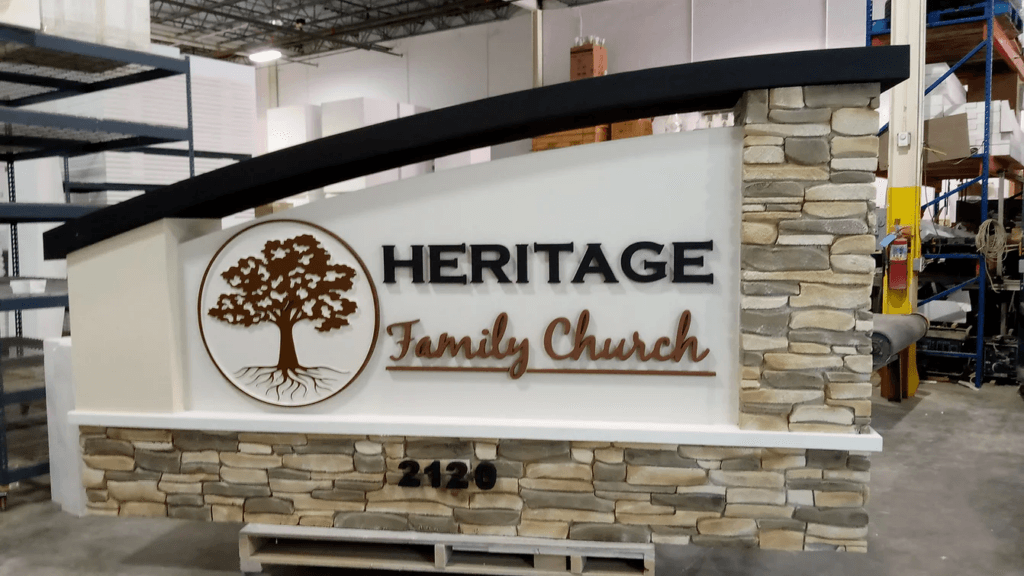
These features become part of the casting itself, creating realistic dimensional surfaces without requiring additional finishing work.
Speed and Efficiency in Production
For large projects, molds dramatically improve manufacturing efficiency.
Once a mold is completed:
- Production becomes faster
- Consistency improves
- Labor requirements decrease
- Project timelines shorten
Instead of recreating each sign individually, manufacturers can cast multiple identical pieces using the same master mold.
This makes molds especially valuable for large-scale developments and commercial projects.
Applications for Stone Sign Molds
Custom molds are commonly used for:
Monument Signs. Community entrances, commercial developments, and property branding.
Wayfinding Systems. Directional signs that require consistent design across multiple locations.
Municipal Projects. Parks, public spaces, and government facilities.
Residential Communities. HOAs, gated communities, and apartment developments.
Educational Campuses. Consistent signage across large properties.
Precision That Lasts Beyond a Single Project
One of the greatest benefits of mold fabrication is long-term scalability.
If a sign is damaged, expanded, or duplicated years later, the original mold can often be used to reproduce matching components.
This provides:
- Future flexibility
- Replacement capability
- Consistent branding
- Reduced redesign costs
For developers and property managers, this long-term value can be significant.
Why Quality Molds Produce Better Signs
Successful cast stone projects start long before casting begins.
High-quality molds provide:
- Sharper details
- Cleaner lettering
- Better texture reproduction
- Greater consistency
- Improved efficiency
The finished sign is only as good as the mold used to create it.
Conclusion
Molds are the foundation of modern cast stone signage. They transform digital concepts into repeatable architectural elements that can be produced accurately, efficiently, and consistently across projects of any size.
3D Sign Factory manufacture custom molds using CNC precision, high-density foam fabrication, and advanced engineering techniques to support monument signs, architectural branding, and cast stone systems. For developers, sign companies, municipalities, and commercial projects, professionally engineered molds provide the accuracy and consistency required to create exceptional stone signage that stands the test of time.

Read more

The Importance of Hard Coating in Outdoor Signage: How Polyurea Coating Transforms Foam Structures into Durable Signage
The Art of Imitation: How Faux Finishes Transform EPS Foam Into Stone, Metal & Wood

Beyond Traditional Materials: Why HDU Foam Is Replacing Wood and Stone in High-End Signage
The Hidden Science Behind High-Quality Foam Lettering & Dimensional Signage
Eco-Friendly Signage Solutions: Is HDU & EPS Foam the Sustainable Choice?

Why Lightweight Foam Monument Signs Are Ideal for Large-Scale Signage

The Importance of Proper Installation for Monument Signs

Foam vs. Metal Signs: Cost, Durability, and Aesthetic Considerations

The Importance of Proper Installation for Monument Signs

From One-Time WOW to Multi-Tour ROI
Recommended Articles
HDU Signs: What High-Density Urethane Foam Is and Why It’s a Premium Sign Choice
Acrylic Signs for Business: Types, Benefits, and How to Choose the Right Style
Industrial 3D Printing: Large-Scale Foam Prototypes, Models & Manufacturing Solutions
Beyond the Booth: How Custom 3D Displays Make Brands Stand Out at Expos and Events
Sandblasted vs. Routed Signs: Which Is Right for Your Project?

Letter Signs: How Dimensional Letter Signage Works for Every Business Type
Our customer reviews
Read more reviewsRead more reviews